
Honeywell Register & Grille Cleaning: The Atlanta Owner’s Guide
We stock and install Honeywell-compatible register and grille cleaning for most residential HVAC systems in Atlanta, with typical service pricing between $89 and $340 depending on system access and contamination level. Most jobs are completed same-day when you call before noon. Homeowners usually notice the problem when rooms stop heating or cooling evenly, or when they spot visible dust buildup around the edges of floor or ceiling registers in older Atlanta homes.
Clean ducts do quiet work. When your Honeywell registers and grilles are clogged with years of accumulated dust, pet dander, and the fine red clay particulate that blows through Georgia spring storms, your system works harder and your air works worse. We’ve been crawling through attics across DeKalb, Fulton, and Gwinnett counties since 2012, and we’ve learned that registers in homes near Piedmont Park or along the tree-heavy streets of Virginia-Highland tend to collect organic debris faster than those in more open terrain. That’s not a theory - it’s what our cameras show us every week.
Which Honeywell Models This Applies To
Honeywell registers and grilles span several product families, and matching the right cleaning approach matters. The most common residential lines we see in Atlanta are the Honeywell Home series (including the TRUaire and Econoline grilles found in homes built from the late 1990s through the 2010s), the older Honeywell Commercial line with stamped-steel construction, and the occasional Honeywell electronic air cleaner interface grille from the 1980s and 90s still running in Buckhead and Druid Hills basements.
To identify your unit, check the stamped model number on the grille frame’s edge or the register’s damper box - it usually starts with a letter code like “TR,” “EC,” or “H.” Measure the rough opening, not the faceplate: a 10×6 register often sits in a 12×8 rough opening, and ordering by face size alone leads to gaps. For the Honeywell electronic air cleaner grilles, the interlock mechanism is proprietary; aftermarket equivalents exist, but the mounting clip spacing must match within 1/8 inch or you’ll fight the install for an hour. We carry adapters for the three most common clip patterns on our trucks.
Bellows Air Duct & Vent Co. of Atlanta is an independent service provider - we’re not affiliated with Honeywell - though we do stock Lennox, Trane, and Carrier compatible parts as well for mixed-system homes.
Signs Your Honeywell Register & Grille Cleaning Is Failing
- Uneven room temperatures. One bedroom runs five degrees hotter than the hallway while another freezes. This usually means the register’s internal damper is stuck with dust and debris, or the grille vanes are so coated that airflow direction is compromised. In Atlanta’s humidity, that dust layer absorbs moisture and hardens like papier-mache.
- Visible black or gray buildup on grille faces. What looks like ordinary household dust often contains mold spores feeding on the organic material trapped behind the register. Homes near the Chattahoochee River or in low-lying Decatur neighborhoods see this more frequently due to higher ambient moisture.
- Whistling or rattling when the system cycles on. The damper blade is oscillating in a turbulent airflow stream because it’s partially obstructed. Left alone, the vibration loosens the mounting screws and can crack the plastic damper box on TRUaire models from the 2000s - a $40 part that becomes a $180 replacement.
- Musty smell when heat or AC first kicks in. The register cavity behind the grille acts as a dead-air trap. Dust plus Atlanta humidity plus occasional condensate drip equals a breeding ground. Cleaning the grille face doesn’t reach the source; the duct opening and boot need attention too.
- Increased dust on furniture near vents. The register isn’t filtering anymore - it’s distributing. When the grille’s internal geometry is clogged, airflow velocity drops, and particles that should stay in suspension settle out on your coffee table instead.
Replacement Cost & What’s Included
Our Honeywell register and grille cleaning service runs $89 to $340 installed in the Atlanta market. The low end covers straightforward cleaning of three to five standard floor or wall registers with good access. The high end reflects hard-to-reach ceiling registers in two-story foyers, heavy contamination requiring rotary brush work inside the duct boot, or systems with the older Honeywell electronic air cleaner grilles that need careful disassembly to avoid damaging the interlock switches.
Here’s how that breaks down:
- Standard register/grille cleaning (per unit): $45-$75
- Duct boot cleaning behind register: $65-$125
- Honeywell electronic air cleaner grille (special handling): $85-$140
- Full system register package (10+ units, whole house): $240-$340
We disclose the full price before we lift a tool. Every job includes before-and-after camera inspection of the ductwork behind at least one representative register, and everything we do carries our 90-Day Done Right Promise in writing. If it’s not right, we make it right - no paperwork, no arguing.
DIY or Call Us?
There’s honest work a homeowner can do, and there’s work that wastes a Saturday and still leaves the problem behind the wall.
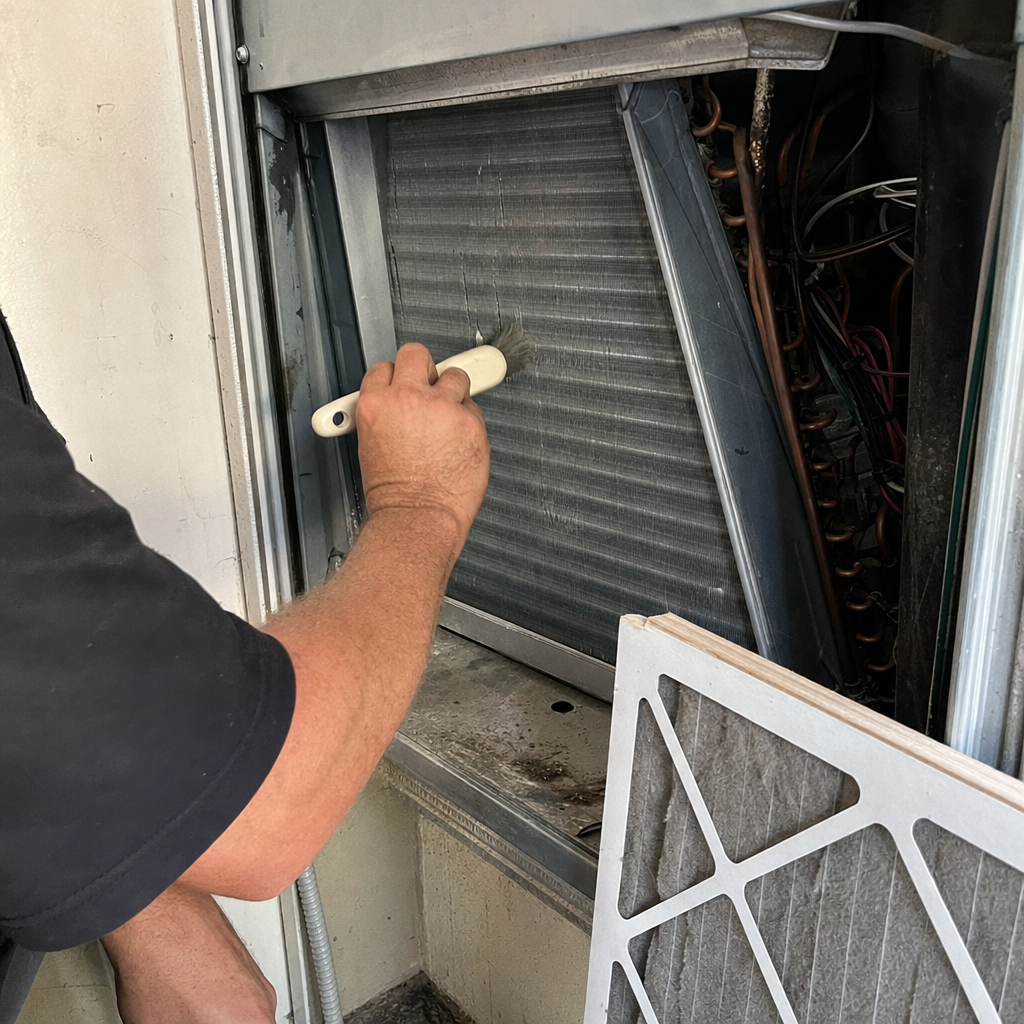
What you can safely check: Remove the register face and vacuum the visible duct opening with a hose attachment. Wipe the grille with mild soap and water. Check that the damper opens and closes freely by hand. These steps handle surface dust and confirm basic mechanical function.
Where DIY goes wrong: The actual contamination lives past the first six inches of duct, in the boot and the trunk line connection. Consumer vacuums lack the sealed suction and rotary brush agitation to dislodge hardened buildup. More importantly, Atlanta’s older homes - especially the post-war brick ranches in Decatur and the 1960s split-levels in Sandy Springs - often have asbestos-containing duct tape or fiberboard boots behind the register. Disturbing these without proper containment is a genuine health hazard. We carry HEPA-contained equipment and know what to look for.
If you’re not certain what you’re opening up, call (855) 305-5564. We’ll give you a straight answer and a price before we schedule.
FAQs
With proper cleaning every three to five years, the metal housings last indefinitely. The plastic damper boxes on TRUaire models from 2000-2015 are the weak point - Georgia’s heat-cool cycles stress the plastic, and we see cracking around year 12 to 15. Call (855) 305-5564 and we’ll inspect yours at no charge during any service call.
Sometimes. A stuck damper can often be freed and lubricated. But if the grille vanes are corroded or the mounting frame is warped from years of overtightening, replacement is the only fix that lasts. We stock the common Honeywell sizes and can swap a standard register in about twenty minutes.
A typical Atlanta home with eight to twelve registers takes two to three hours, including camera inspection and reassembly. Whole-house packages are completed in a single visit by our background-checked, uniformed technicians.
Yes. We carry adapters for the three most common Honeywell mounting clip patterns, rotary brush heads sized for residential duct boots, and HEPA-contained vacuum equipment. For electronic air cleaner grilles, we verify your model number by phone so we arrive with the right hardware.
Ready to get this handled? Call (855) 305-5564 for a free estimate. We’ll be there when we say, show you one honest price before we start, and stand behind the work for 90 days - no paperwork, no arguing. That’s been our way since 2012.
Written by Cliff Darden, Owner, Bellows Air Duct & Vent Co. of Atlanta at Bellows Air Duct & Vent Co. of Atlanta, serving Atlanta and nearby areas.