
Abatement Technologies Vent Sanitizing: The Atlanta Owner’s Guide
We stock and install Abatement Technologies-compatible vent sanitizing components for residential HVAC systems across Atlanta, with most jobs priced between $280 and $520 installed, depending on system size and access. Same-day service is available when you call before noon, and our trucks carry the common Abatement Technologies UV-C and photocatalytic oxidation assemblies used in metro Atlanta homes. Most Atlanta homeowners discover their vent sanitizing has failed when they notice a return of musty odors after years of clean-smelling air, or when a routine filter change reveals visible microbial growth on supply registers that the unit used to keep in check.
Which Abatement Technologies Models This Applies To
Abatement Technologies builds several vent sanitizing product lines, and matching the right assembly to your specific unit matters more than many homeowners realize. The CAP600 series, common in Atlanta homes built between 2005 and 2015, uses a 16-inch UV-C lamp housing with a proprietary twist-lock base that does not interchange with the newer CAP800-UV series. The older CAP300 units, still running in plenty of Decatur and Grant Park basements, have a two-pin ceramic socket that Abatement Technologies discontinued around 2012; for these, we source quality aftermarket equivalents that carry the same 9,000-hour lamp life rating at roughly half the OEM cost.
To identify your unit, look for the silver data plate on the lamp housing itself, not just the air handler cabinet. The model prefix tells the story: CAP denotes the residential line, while HEPA-CAP indicates the commercial-grade units occasionally retrofitted into larger Druid Hills or Morningside homes. We photograph this plate during every estimate so there’s no guesswork on the order. Bellows Air Duct & Vent Co. of Atlanta is an independent service provider with no affiliation to Abatement Technologies; we simply specify their equipment because it holds up well in Georgia’s humid shoulder seasons when microbial growth pressure is highest.
The OEM-versus-aftermarket question comes up often. Abatement Technologies OEM lamps carry their brand markup and a 12-month warranty through authorized channels. The aftermarket lamps we source are manufactured by the same bulb foundries in Tennessee and Ohio, with identical UV-C output at 254 nanometers and the same quartz glass envelope rated for 800 thermal cycles. For most Atlanta homeowners, the aftermarket route saves $80 to $140 without sacrificing performance. The exception is the CAP800-POX photocatalytic series, where the titanium dioxide grid is a proprietary geometry; here, OEM is the only reliable path.
Signs Your Abatement Technologies Vent Sanitizing Is Failing
- Persistent musty or “locker room” odor from supply vents. The UV-C lamp degrades predictably, losing roughly 15% of its germicidal output every 1,000 hours even when the blue glow still looks fine to the eye. In Atlanta’s climate, where indoor humidity routinely climbs above 60% from March through October, that degraded output falls below the threshold needed to suppress mold and bacterial growth on the coil and drain pan.
- Visible microbial staining on supply registers or nearby ceiling tiles. When the sanitizing assembly was working, it kept the downstream ductwork biologically inactive. New growth near the register usually means the lamp has been dead or degraded for at least one full cooling season, long enough for spores to establish colonies in the moist supply air.
- The indicator light is on but odor control has vanished. This is the classic Abatement Technologies gotcha: the low-voltage LED draws from a separate transformer circuit and can glow happily while the main lamp has failed open. We see this mislead homeowners in Sandy Springs and Buckhead regularly; the glow means power, not function.
- Increased allergy or asthma symptoms after years of stability. Cliff Darden’s daughter’s childhood asthma is part of why this symptom matters to us personally. When a working sanitizing assembly goes quiet, the allergen load in circulated air can double within a single Georgia summer as the evaporator coil becomes a biological reservoir.
- Annual energy bills creeping up with no equipment change. A bio-fouled evaporator coil loses heat transfer efficiency, forcing the compressor to run longer cycles. The sanitizing assembly’s real job is keeping that coil clean; when it fails, the energy penalty shows up gradually, $12 to $20 a month in a typical 2,500-square-foot Atlanta home.
Replacement Cost & What’s Included
For standard residential Abatement Technologies vent sanitizing replacement in the Atlanta market, most homeowners pay between $280 and $520 installed. The lower end covers a straightforward CAP600 UV-C lamp swap with an aftermarket equivalent, accessible through a standard filter door. The upper end reflects the CAP800-POX units with OEM titanium dioxide grid, tight attic access in older Virginia-Highland or Inman Park homes, or systems requiring minor electrical rework when the original ballast has failed.
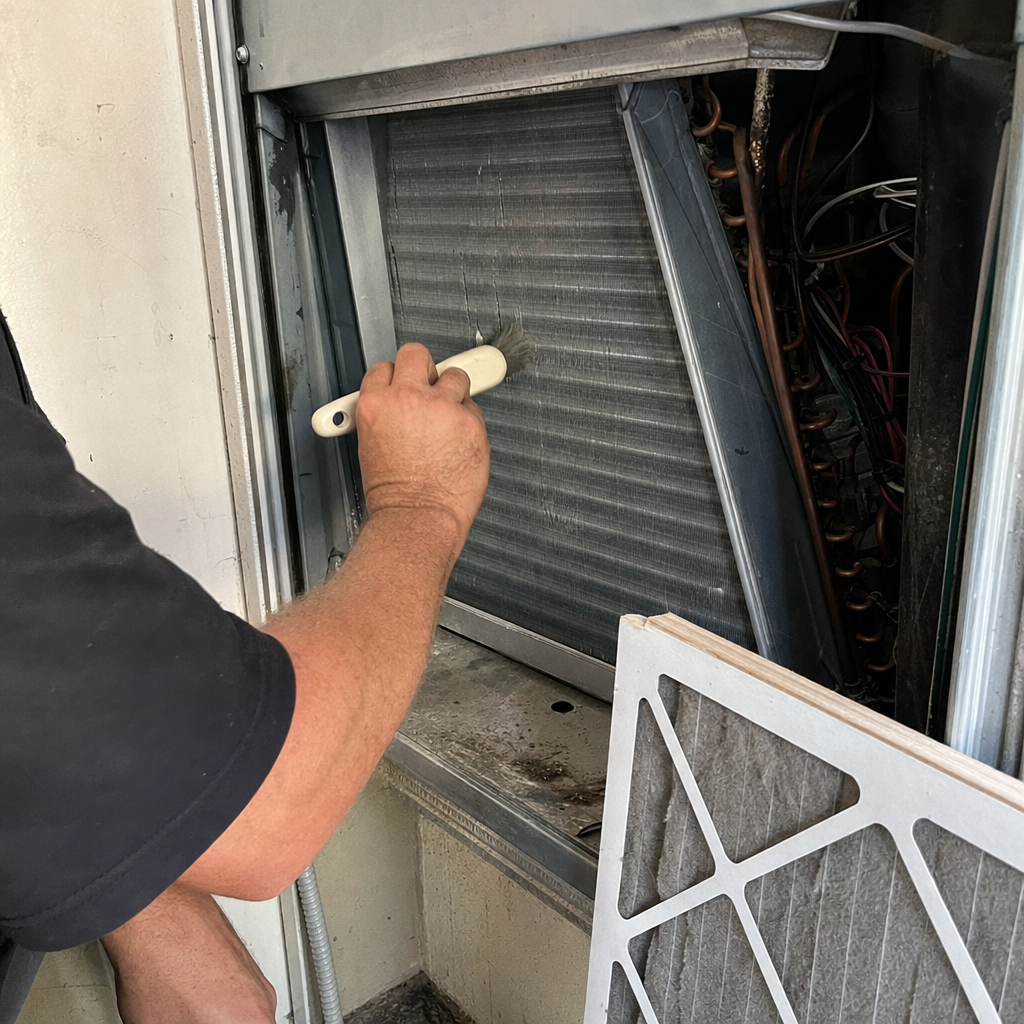
Every replacement includes camera inspection of the evaporator coil and downstream ductwork before we start, so you see exactly what the failed unit allowed to develop. We show you the same view after installation. Parts, labor, and the 90-Day Done Right Promise are wrapped into one number disclosed before we touch a tool. If the lamp fails or the odor returns within 90 days, we return at no charge with no paperwork required. That’s been our policy since 2012, and it’s not changing.
| Component / Scenario | Typical Range |
|---|---|
| CAP600 UV-C lamp, aftermarket | $280 - $360 |
| CAP600 UV-C lamp, OEM | $340 - $420 |
| CAP800-UV with ballast replacement | $380 - $480 |
| CAP800-POX, OEM grid and lamp | $440 - $520 |
| Tight access or attic routing add | $60 - $90 |
DIY or Call Us?
There is a safe middle ground here, and then there is a hard stop. A homeowner can safely confirm power at the unit with a non-contact voltage tester, inspect the lamp for the gray banding that indicates end-of-life tungsten migration, and check the data plate for the model number before calling. What we do not recommend is removing the lamp housing, handling the quartz envelope with bare fingers, or attempting to bypass a failed ballast. UV-C lamps operate at high voltage and the quartz glass degrades with skin oils, creating a hot spot that can fracture the envelope during operation. The ballast circuit, even on 120-volt residential units, can deliver a dangerous kick.
If your Abatement Technologies unit is more than eight years old, the lamp, ballast, and socket often degrade together; replacing one without inspecting the others is a short-term fix that wastes the trip. We carry the full replacement assemblies on our trucks, test the entire circuit with a multimeter, and warranty the work. For a straight answer on what your specific system needs, call (855) 305-5564. Estimates are free, and most replacements are done in a single visit.
FAQs
Rated lamp life is 9,000 hours, which translates to roughly 12 to 15 months of continuous operation in most Atlanta homes. In practice, we recommend annual replacement because Georgia’s humidity and long cooling season push the biological load higher than the manufacturer’s baseline assumptions. After 12 months, even a glowing lamp has lost enough output to matter. Call (855) 305-5564 and we’ll check yours during any service visit.
No. UV-C lamps are sealed glass envelopes with no serviceable components; once the filament degrades or the gas fill depletes, replacement is the only option. Ballasts and sockets can sometimes be repaired, but in our experience across Atlanta, a failed lamp usually means the supporting components are near end of life too. We inspect the full circuit so you don’t pay twice.
Most Abatement Technologies vent sanitizing replacements take 45 to 90 minutes from truck arrival to final test, including the before-and-after camera inspection. Tight attic access or the need to replace a ballast can stretch that to two hours. We schedule with realistic windows and call when we’re en route so you’re not waiting.
We carry the common CAP600 and CAP800 UV-C assemblies, both OEM and quality aftermarket, along with matching ballasts and sockets. The CAP800-POX photocatalytic grids are ordered to specific serial number ranges due to the proprietary geometry, but we can typically have them within 24 hours. If you call with your model number, we’ll confirm stock before we roll. Reach us at (855) 305-5564.
Clean ducts do quiet work. If your Abatement Technologies vent sanitizing has gone quiet and the odors are creeping back, we’ll get it straightened out in one visit, show you the camera proof, and put the 90-Day Done Right Promise behind it. No bait pricing, no surprises on the bill, just a square deal from a company that’s been doing this since 2012. Call (855) 305-5564 for a free estimate.
Written by Cliff Darden, Owner, Bellows Air Duct & Vent Co. of Atlanta at Bellows Air Duct & Vent Co. of Atlanta, serving Atlanta and nearby areas.